This APi provides all the routes needed to implements a platform where Madam sauce Customers at GenesysTechHub can place order for their meal and it will be delivered to their offices. This project was designed with expressjs, nodejs and Mongodb
USER ROUTE
Sign Up Route {url}/user/signup
The Sign up Route handles the user registration. here is a sample Json snippet.
The Login Route handles the User Login. An example of json snippet to pass. {
"email": "joshua@gmail.com",
"password": "12345678"
}
User Update Route {url}/user/edit/:id
The user update route handles the profile update of the user. This route requires user authorization. This means user must login before he can update details.
PS: User authorization and Admin role validation are passed as Middlewares form the ./Middlewares/auth.js directory
Get All user Route {url}/user/all
This is route is only accessible for users with admin Role.
Get Specific User Route {url}/user/:id
This route gets a specific user details.
Delete User Route{url}/user/delete/:id
This route deletes a User record but requires an Admin Authorization
MEAL ROUTE
Get all the Meal {url}/meal/all
This route get all the Meals added by the admin. This is visible to all type of users
Add Meal {url}/meal/add
This route is for adding new meal to the Meal list. Only an admin can access this route. A simple json file to pass:
This route is for users to cancel their Meal order. Just pass the order id as a payload. Example: {
"orderId" : "5f893c3bec48542e24c1e566"
}
Complete Order {url}/order/complete
This route is for users to complete their Meal order once it is delivered. Just pass the order id as a payload. Example: {
"orderId" : "5f893c3bec48542e24c1e566"
}
Delete Order {url}/order/delete/:id
This route is for admin to delete an Order record. Just pass the order id as a params.
Check A user Order record {url}/order/my
This route is for users to View their order records
All Order {url}/order/all
This route is for admin to check all order record in the DB
Ox-Rst exports your Org documents to reStructuredText.
Ox-Rst relies on the Org-mode 9.0 export framework.
Configuration
Add the following in your init.el
(require'ox-rst)
reStructuredText export
ox-rst export back-end generates reStructuredText syntax for
an Org mode buffer.
reStructuredText commands
To export your org document to, press C-c C-e, and then r.
C-c C-e r r (org-rst-export-to-rst)
Export as a text file written in reStructured syntax.
For an Org file, myfile.org, the resulting file will be myfile.rst.
The file will be overwritten without warning.
C-c C-e r R (org-rst-export-as-rst)
Export as a temporary buffer. Do not create a file.
Title, Author, E-Mail and Date
Org:
#+TITLE: This is the title of the document
#+AUTHOR: Author
#+EMAIL: mailaddress@example.com
#+DATE: 2019/08/13 00:00
#+OPTIONS: author:t date:t email:t
reStructuredText:
=================================
This is the title of the document
=================================:Author: Author
:Contact: mailaddress@example.com
:Date: 2019/08/13 00:00
** Lord of the Rings
1. The attack of the Rohirrim
2. Eowyn's fight with the witch king
   + this was already my favorite scene in the book
   + I really like Miranda Otto.
3. Peter Jackson being shot by Legolas
   - on DVD only
   He makes a really funny face when it happens.
But in the end, no individual scenes matter but the film as a whole.
Important actors in this film are:
- Elijah Wood :: He plays Frodo
- Sean Austin :: He plays Sam, Frodo's friend.  I still remember
  him very well from his role as Mikey Walsh in The Goonies.
reStructuredText:
Lord of the Rings
~~~~~~~~~~~~~~~~~

1. The attack of the Rohirrim

2. Eowyn's fight with the witch king

   - this was already my favorite scene in the book

   - I really like Miranda Otto.

3. Peter Jackson being shot by Legolas

   - on DVD only

   He makes a really funny face when it happens.

But in the end, no individual scenes matter but the film as a whole.
Important actors in this film are:

Elijah Wood
    He plays Frodo

Sean Austin
    He plays Sam, Frodo's friend.  I still remember
    him very well from his role as Mikey Walsh in The Goonies.
Special Characters
Org:
special characters * asterisk \ backspace
.. reStructuredText comment line
reStructuredText:
special characters \* asterisk \\ backspace
\.. reStructuredText comment line
Paragraphs
note Org line breaks \\ will be ignored.
Verse block
Org:
#+BEGIN_VERSE
 Great clouds overhead
      Tiny black birds rise and fall
      Snow covers Emacs

          -- AlexSchroeder
#+END_VERSE
reStructuredText Line Blocks:
|Great clouds overhead|Tiny black birds rise and fall|Snow covers Emacs||-- AlexSchroeder
Quote block
Org:
#+BEGIN_QUOTE
Everything should be made as simple as possible,
  but not any simpler -- Albert Einstein
#+END_QUOTE
reStructuredText Literal Blocks:
::

    Everything should be made as simple as possible,
      but not any simpler -- Albert Einstein
Org:
#+ATTR_RST: :margin 4
#+BEGIN_QUOTE
Everything should be made as simple as possible,
but not any simpler -- Albert Einstein
#+END_QUOTE

#+ATTR_RST: :margin 8
#+BEGIN_QUOTE
Everything should be made as simple as possible,
but not any simpler -- Albert Einstein
#+END_QUOTE
reStructuredText Block Quotes:
Everything should be made as simple as possible,
but not any simpler -- Albert Einstein

    Everything should be made as simple as possible,
    but not any simpler -- Albert Einstein
Org:
#+ATTR_RST: :directive note
#+BEGIN_QUOTE
Everything should be made as simple as possible,
but not any simpler -- Albert Einstein
#+END_QUOTE
reStructuredText Directives:
.. note::

    Everything should be made as simple as possible,
    but not any simpler -- Albert Einstein
Org:
#+ATTR_RST: :directive sidebar :title sidebar title
#+BEGIN_QUOTE
Everything should be made as simple as possible,
but not any simpler -- Albert Einstein
#+END_QUOTE
reStructuredText Directives with title:
.. sidebar:: sidebar title

    Everything should be made as simple as possible,
    but not any simpler -- Albert Einstein
Special blocks
Org:
#+BEGIN_caution
This is the second line of the first paragraph.
#+END_caution
reStructuredText:
.. caution::

    This is the second line of the first paragraph.
Org:
#+ATTR_RST: :title This is a note admonition.
#+BEGIN_note
This is the second line of the first paragraph.
#+END_note
reStructuredText:
.. note:: This is a note admonition.

    This is the second line of the first paragraph.
Center block
Center block will not affect.
Org:
#+BEGIN_CENTER
center block
#+END_CENTER
reStructuredText:
center block
Literal examples
example block
Org:
#+NAME: label
#+BEGIN_EXAMPLE
example
#+END EXAMPLE
* footnote sample

Org mode[fn:org] is for keeping notes, maintaining TODO lists, planning projects, and authoring documents with a fast and effective plain-text system.

reStructuredText[fn:rest] is plaintext that uses simple and intuitive constructs to indicate the structure of a document.

[fn:org] org-mode [[http://orgmode.org]]
[fn:rest] reStructuredText [[http://docutils.sourceforge.net/docs/ref/rst/restructuredtext.html]]
reStructuredText:
footnote sample
---------------

Org mode [2]_  is for keeping notes, maintaining TODO lists, planning projects, and authoring documents with a fast and effective plain-text system.

reStructuredText [1]_  is plaintext that uses simple and intuitive constructs to indicate the structure of a document.


.. [1] reStructuredText `http://docutils.sourceforge.net/docs/ref/rst/restructuredtext.html <http://docutils.sourceforge.net/docs/ref/rst/restructuredtext.html>`_

.. [2] org-mode `http://orgmode.org <http://orgmode.org>`_
Export reStructuredText fragments
Org:
See also @@rst::meth:`mypackage.mymodule.MyClass.mymethod()`@@.

#+RST: .. class:: alert

#+BEGIN_EXPORT rst
.. class:: alert
#+END_EXPORT
reStructuredText:
See also :meth:`mypackage.mymodule.MyClass.mymethod()`.

.. class:: alert

.. class:: alert
Kanau is an educational web app to aid knowledge retention for Japanese learners through the presentation of flashcards. The review interval of these flashcards are calculated based on how well a user remembers them. It also contains a self-hosted Japanese Dictionary, complete with sample sentences and an easy add-to-card feature. Click here for the full specification of the project.
Clone the project either by directly downloading the repository here, or using the command below. (Note: git should be installed in your system for you to be able to use this command).
Navigate to the project folder – the folder containing the contents of the cloned or downloaded repository.
Run the command npm install to initialize and install all necessary modules used in the project.
To run the server locally, a .env file is required. It was not included in the repository since it contains sensitive information. Please ask the owners for the .env file. Once acquired, place the .env file in the root directory of the project.
Running the Application
Open Command Prompt.
Navigate to the project folder – the folder containing the contents of the cloned or downloaded repository.
Run the command node app.js. If the app is working properly, your Command Prompt should display the following statement:
Lastly, the generated file will be located inside build/generated/ksp/, but your IDE might not
able to identify it. In such case you can add it manually like below:
In real world you might want to pass value from Adapter to ViewHolder. If you want to achieve
this just label the parameter with the same Annotation from both side than we will help you to
link them together. For Adapter, please add parameter in constructor. For ViewHolder, you can
choose either constructor or the bind function which has @BindFunction.
Note: There’s not type restriction for the parameter and we also don’t force them to be equal, but
it will compile fail if it can’t match.
Contributing
It’s an interesting project to me and it’s also in very early stage for now. Any thing can be
changed and any kind of contribution or participate is welcome. Feel free to ask questions or report
bugs. And we’re also welcome you to create new pr if you have any idea!!
License
The module is available as open source under the terms of
the MIT License.
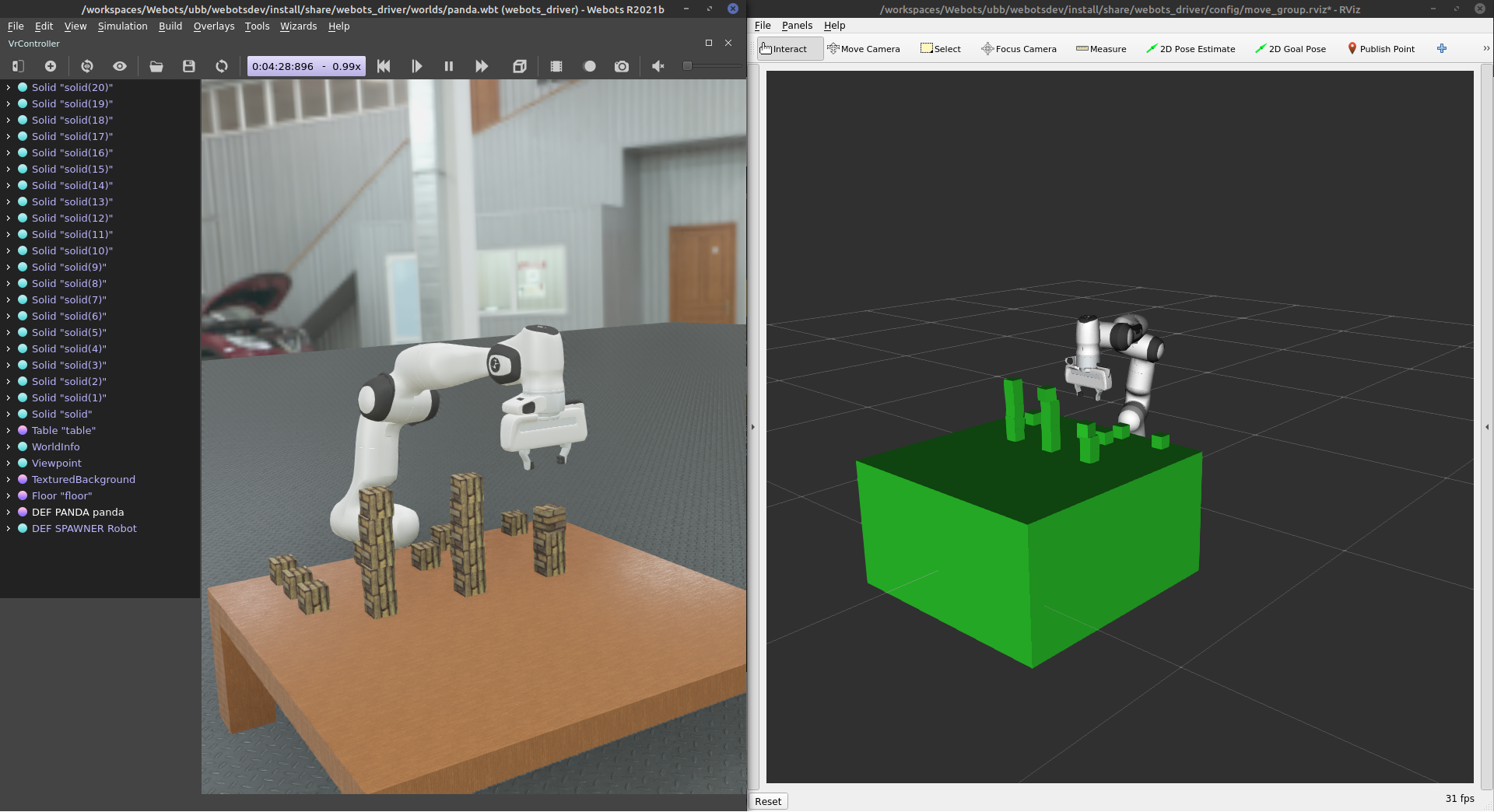
This task involves one Franka Panda robotic arm randomly taking 5cm cubes from a table with 21 cubes arranged in a 7 * 3 grid and stacking them. It will stack them into 3 stacks of 5 cubes. The number of columns and the the heigt can be configured in moveit_controller.launch.py
Throw Task
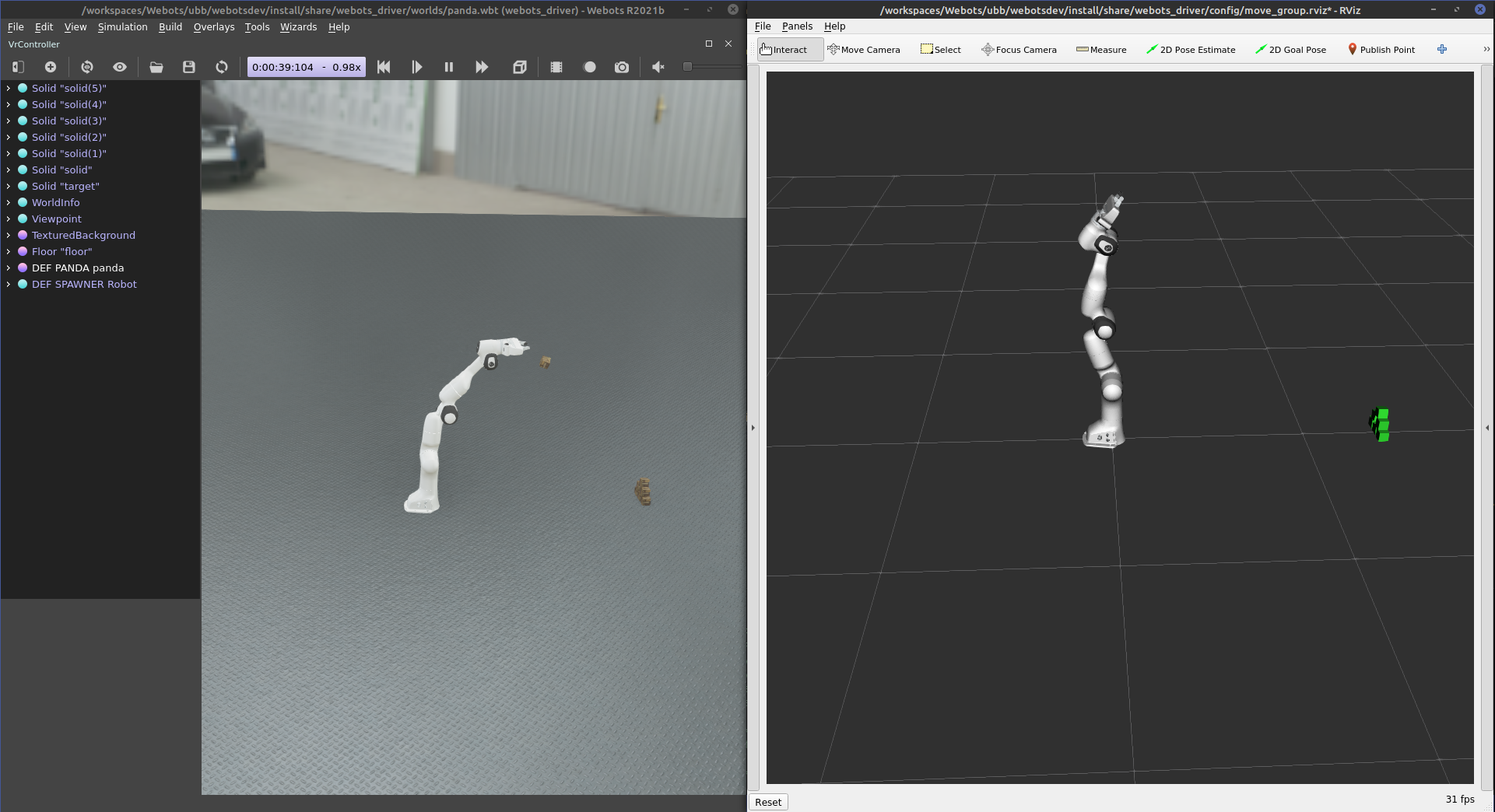
For this, a Franka Panda arm will pick up a cube and throw it toward a pyramid made of 6 cubes. The arm will go as far back as it can and perform a throwing motion toward the ground in front of it. The ball will be released at 50% of the trajectory as it is the moment with the most amount of forces. The pyramid is placed such that a successful throw at full power will collapse it.
Instructions
Requirements
OS: Ubuntu 20.04 (Focal)
Other distributions might work (not tested).
Dependencies
These are the primary dependencies required to use this project.
Install/build a version based on the selected combination of ROS 2 release and Ignition version
Building
Clone this repository and import submodules. Then install dependencies and build with colcon.
# Install pyquaternion
pip install pyquaternion
# Clone this repository and the submodules into your favourite ROS 2 workspace
git clone https://github.com/09ubberboy90/simple_webots_ros2.git
# Install external dependencies via rosdep
rosdep install -r --from-paths src --ignore-src --rosdistro ${ROS_DISTRO}# Build with colcon
colcon build --merge-install --symlink-install --cmake-args "-DCMAKE_BUILD_TYPE=Release"
Sourcing
Before utilising this package, remember to source the ROS 2 workspace overlay.
source${ROS2_WS}/install/local_setup.bash
Running
The following tasks can be either run as an independant launch or can be recorded
Stacking cube
ros2 launch webots_driver stack_cubes.launch.py
Throwing cube
ros2 launch webots_driver throw_cubes.launch.py
Recorder
The recorder can be launched with.
ros2 run sim_recorder run_recording
It has some argument option to configure what the task will be
--help: Gives a list of arguments
-t, --throw: Start the Throwing Task
-i, --iteration: Number of run that should be performed
-s, --start: Start index in case some run need to be rerun after an interuption
--headless: runs without a GUI
The recorder will save the CPU and RAM usage in sim_recoder/data/{sim_name}.
sim_name is created automatically based ont the simulation name ignition and on the arguments:
_gui is added if --headless is not passed
_throw is added if --throw is passed
An analysis of the run can be performed by running from the source of the repo
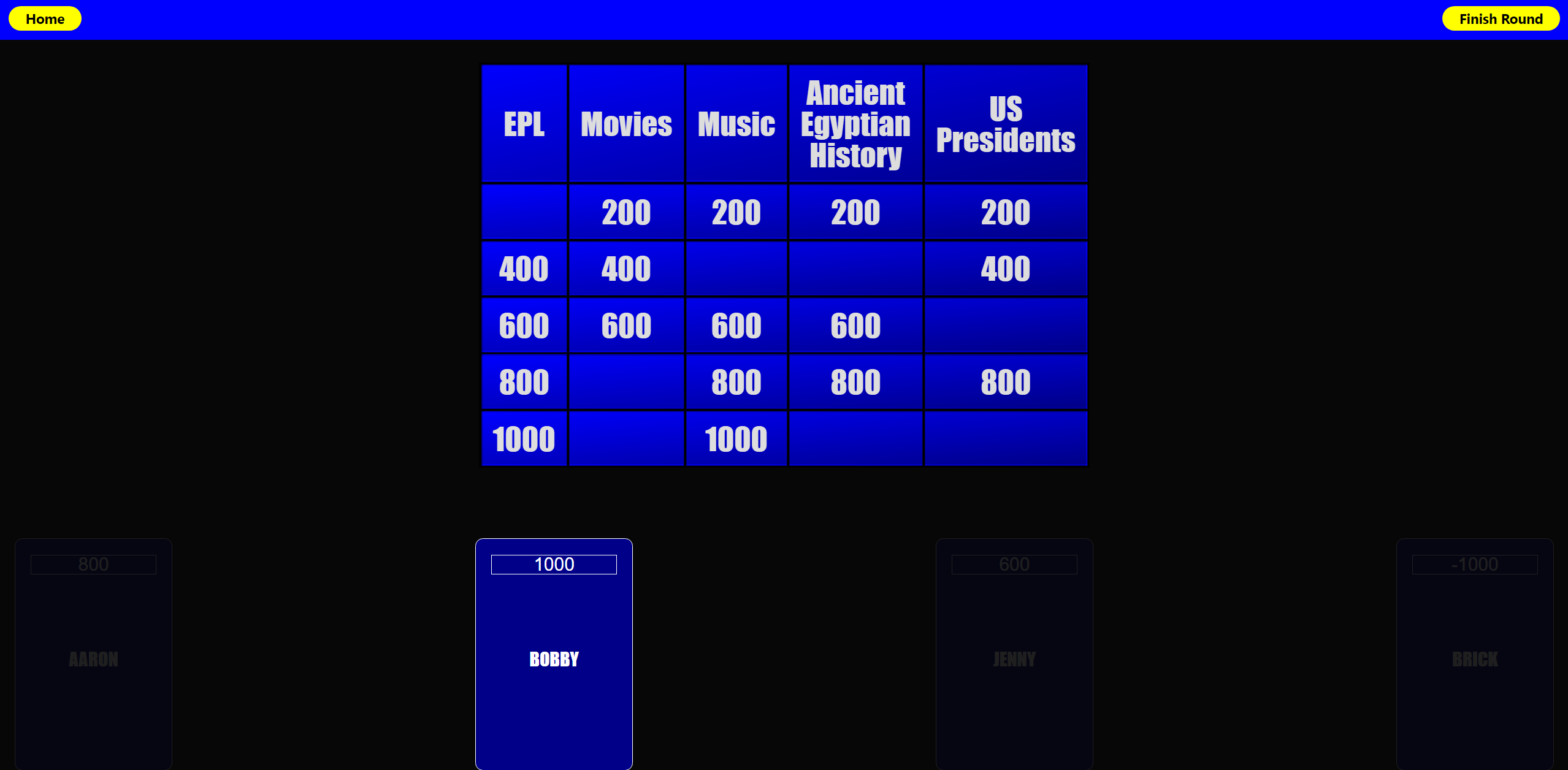
QuizShowGPT is a game that fuses AI large language learning model with Jeopardy style quiz shows!
How it works
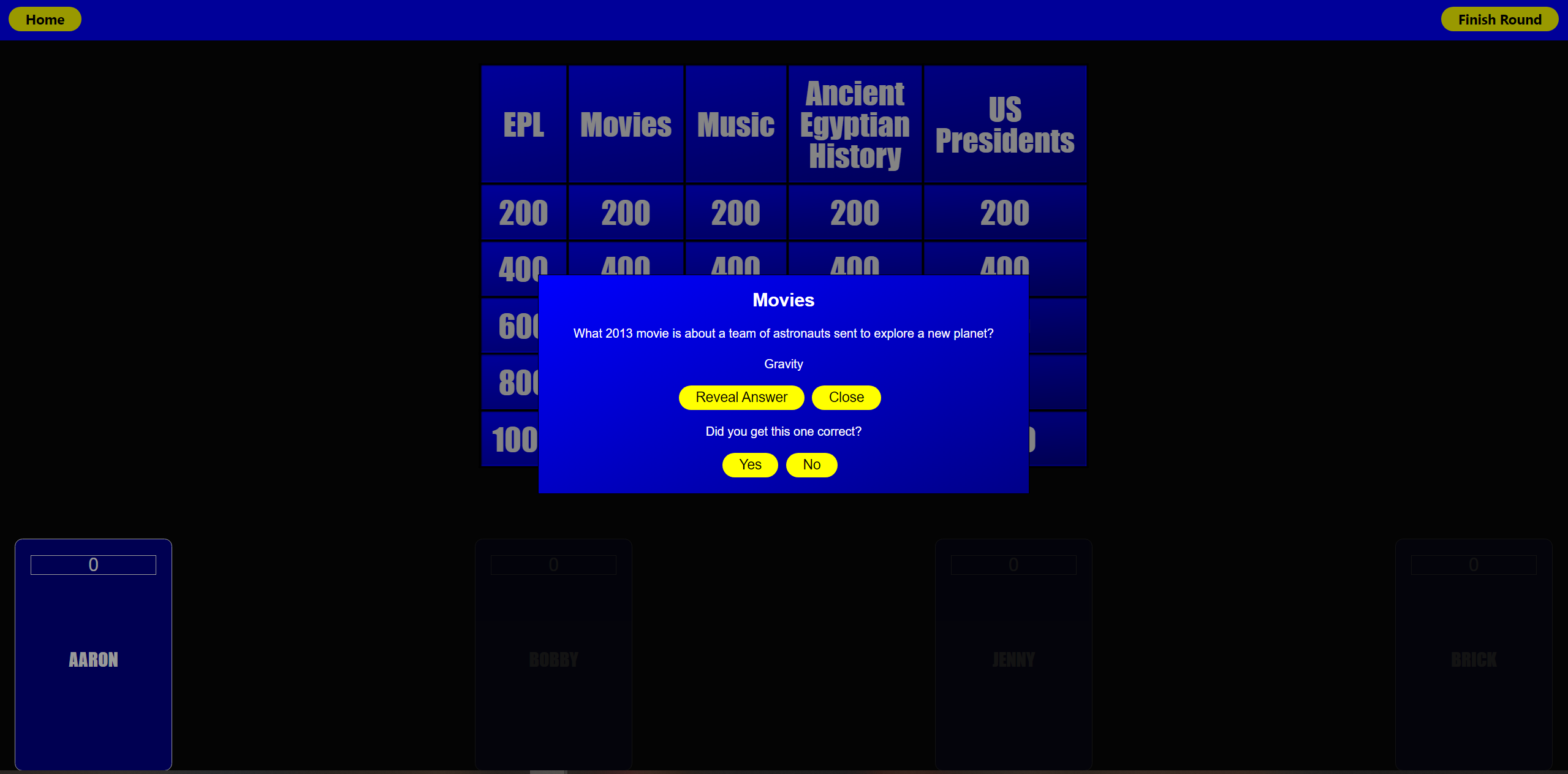
This app uses OpenAI’s ChatGPT to generate questions for a game of Jeopardy.
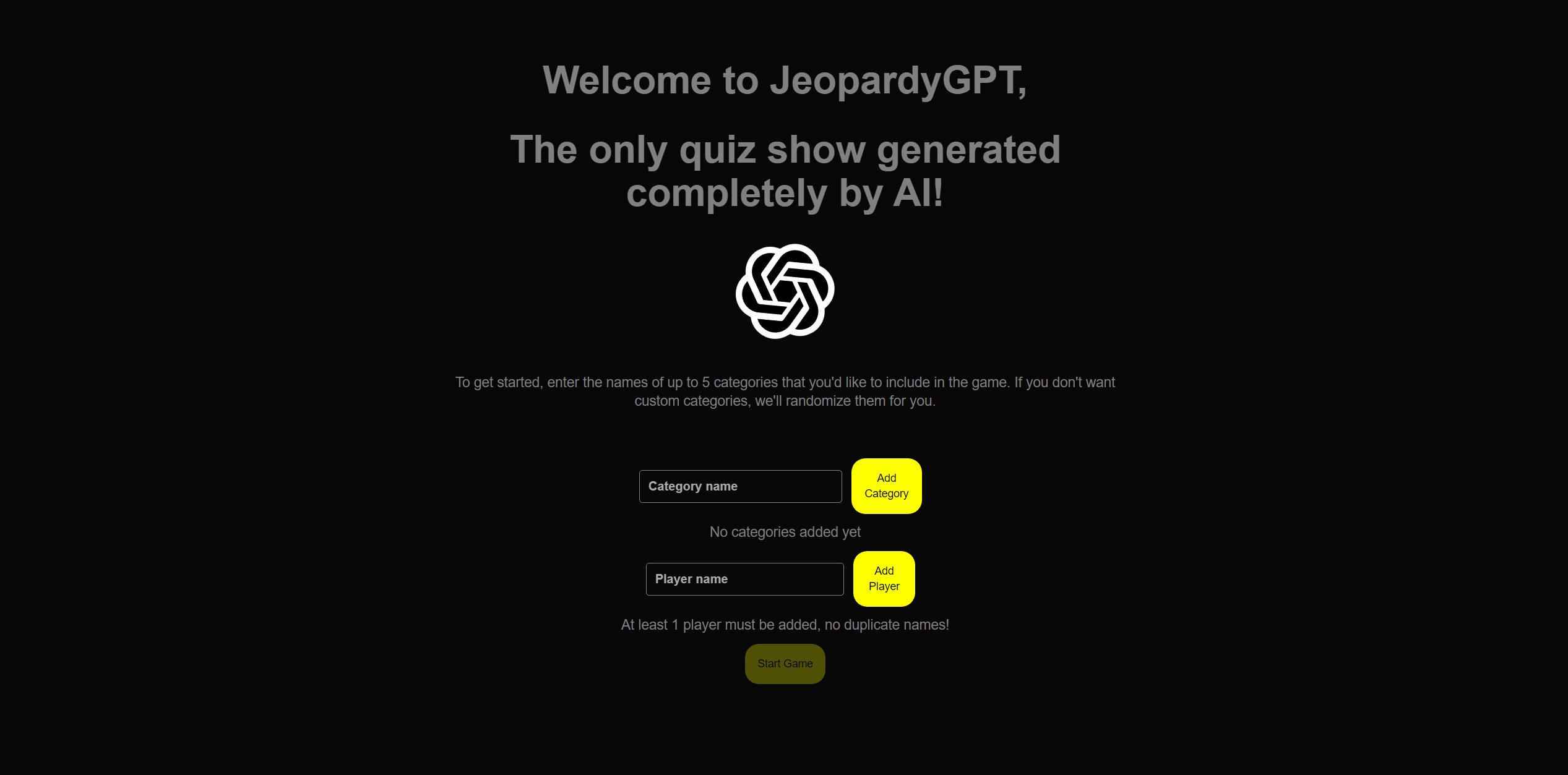
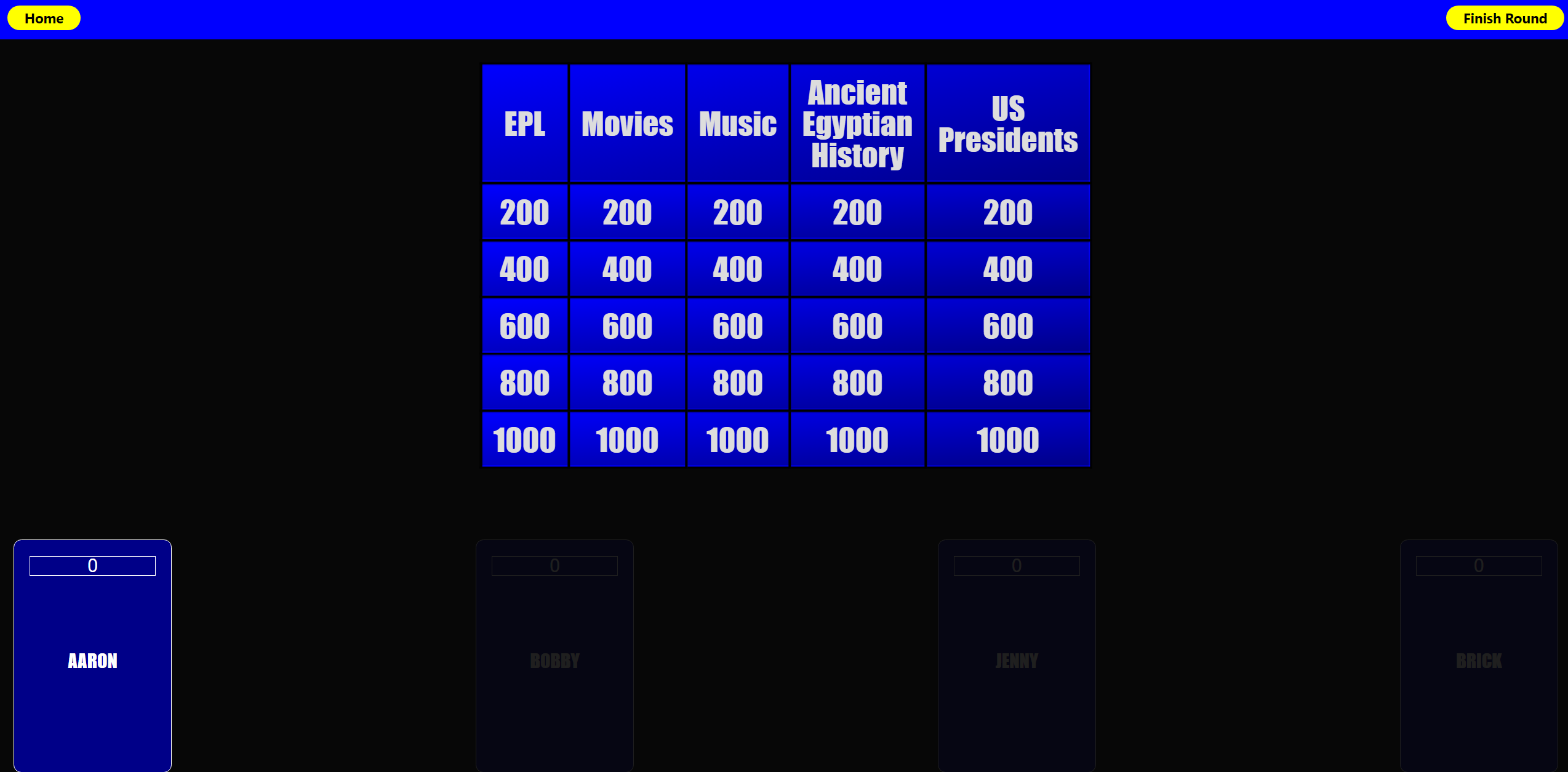
User can enter custom categories for ChatGPT to use when creating questions. If the user enters less than 5 or no categories, the game will generate categories for you.
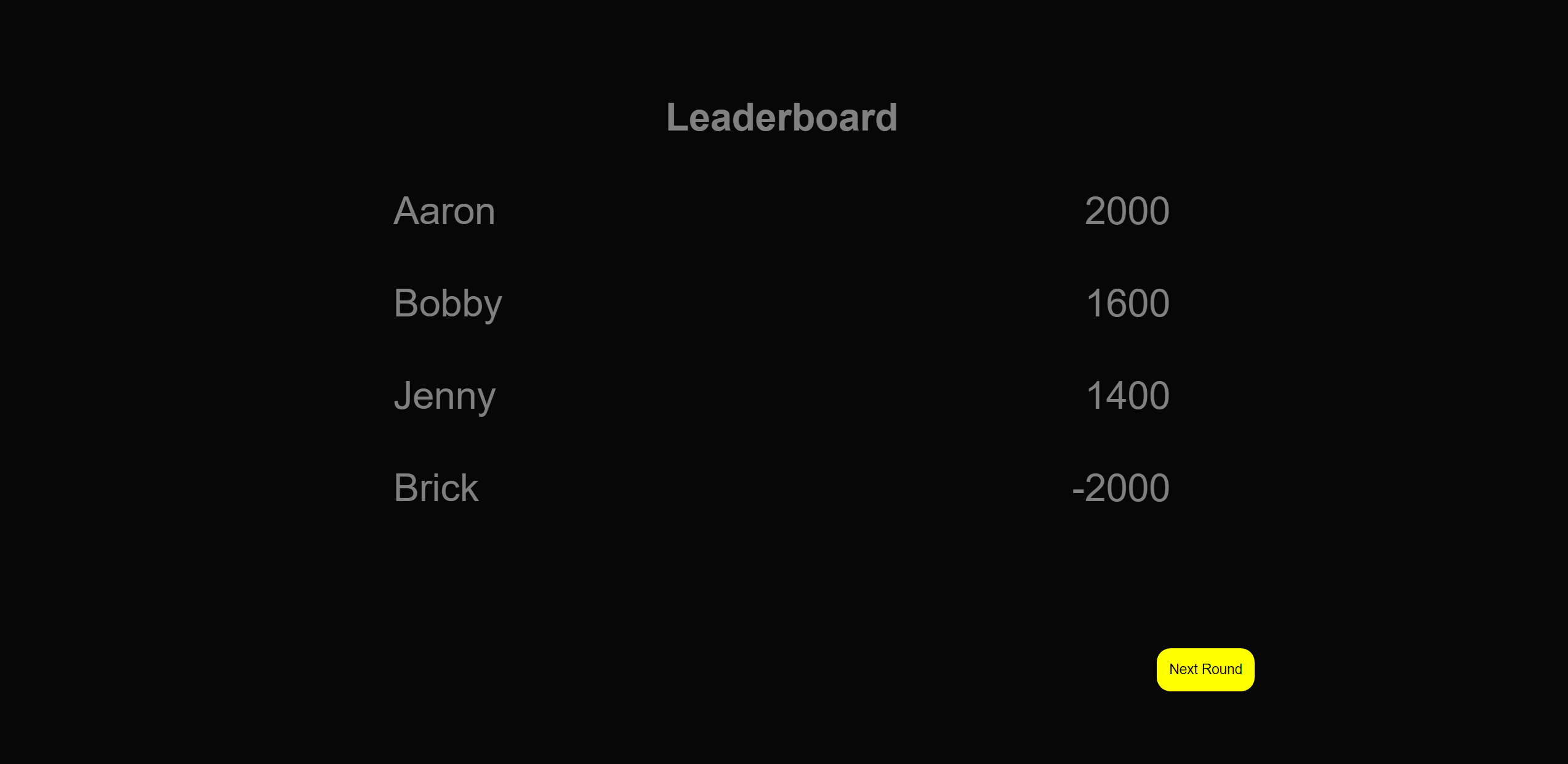
There are 2 rounds, with a leaderboard in netween rounds.
The score and questions data is stored in the browser’s window session so any accidental refresh will not result in a new call to OpenAI.
Make sure to click the current player’s scoreboard so the score is added to the correct player.
Coming soon
“Re-gen” button that allows user to regenerate the board if the questions are bad
Database functionality so save good questions boards
user feedback for good/bad game boards to improve results from ChatGPT
Dev notes
Be aware that some of the information generated by ChatGPT may be incorrect (I know, not really ideal for a trivia game right?) ChatGPT is constantly evolving and getting better at responding to prompts, so keep that in mind!
ChatGPT has a limited understanding of the world over the last few years.
More vague categories may result in easier questions
Hyper-specific categories may result in repeated or easier questions
Be aware that the idea of Jeopardy is to have increasingly difficult questions as the point value gets higher, but ChatGPT is hit-or-miss when it comes to scaling difficulty of the questions. ie the 1000 point question may be easier than the 200 point question.
Other notes / improvements
Consolidate styling
Improve file structure
Database functionality (models are present, but not hooked yet)
Litmus is a purpose built expressjs and polkadot based RESTful API to demonstrate Node.js and Web3.0 skills.
It offers two APIs:
POST /api/v1/signin
It offers authentication by using substrate account and signature verification, and returns a API signed bearer token as identity for substrate account. Please see the demo section.
GET /api/v1/secret
Its token authenticated API that returns random magic strings from Postgres.
The app uses some of the famous npm packages, i.e. express, joi, dotenv, prisma ORM, passport, pino logger with ECS formatting, and more importantly polkadot to verify signatures.
How it works:
Call /challengecode API with your address aka username, and it will give you an arbitrary challenge code that expires after 3 minutes.
Call /signin API with your username, a message containing your username and the challenge code, signature of the message, and the challenge code
If everything works, it will give an signed token that you can use to call other endpoints of Litmus API, for example /secret.
Web3 Version:
Switch to dev branch for Web3 version, that uses Polkadot account for auth.
MakerDAO’s value proposition is stability. There’s a few key things that effect stability, I believe the primary contributors are:
Information – How much does your audience understand about the system they’re participating in? A long-term BTC holder is going to have stronger hands during a 30% drop in price, whereas a newer BTC holder may not be as informed, and thus “weak” hands in situations that may be short-term troublesome.
The blackswan risk for MakerDAO’s system is not the same if Alice Smith was the only CDP holder compared to Joe Lubin being the only CDP holder.
Predictability – Any scenario where there’s volatility, be it in cryptocurrency markets, or sports, or games carrying mixture of skill & chance. The more information that your opponent has in advance, the more they can attempt to predict a certain number of potential strategies that they may be faced with. Like knowing the lineup that will be played for the superbowl team, a coach will use that to mitigate any potential variance.
Something else that I’ve forgotten because I had it on a shitty gist.
🤖Data driven decisions for the following:
Debt Ceiling (SCD & MCD).
CDP ownership/accessibility.
Stability Fee.
Dai Savings Rate.
Oracles & Pricing.
Collater Pool.
🗳Governance driven decisions for the following:
Exchange venues eligible for price discovery.
Oracles integrity and transparency.
Market maker incentives.
Strategy to introduce new asset classes (native on-chain BTC vs tokenized property/securities)
Newer assets to be introduced to the the system.
The further evolved a system becomes, the harder it is to make changes. Early decisions have ongoing effects. Imagine what the ecosystem would look like today if we saw Satoshi create irreversible digital currency and go push it weeks later on gambling and adult forums as a payment method. The shortsighted approach would’nt have given us the foundations we’ve got today. Similarly to MakerDAO being selective in MKR issuance, instead of spraying and praying. Tight foundations are absolutely necessary for a system over the long term.
Below are a series of calculations that I believe construct a more liquid, more scalable & predictable system. Removing the key variables that challenge the core value prop. Stability.
Theoretically hitting the reset button on the system. 0 CDP’s open, 0 collateral, 0 collateral pool.
💸 CDP’s
0 CDP’s available in the system. To generate a CDP, a verifiable on-chain trade must be completed between the collateral and the stable asset. DAI/ETH trade.
1 CDP is able to be generated for every on-chain trade that is verifiable (e.g. a DAI/ETH trade on Uniswap).
The person who completed the trade receives an ongoing decaying portion of the stability fee’s paid on that specific CDP, or is paid a portion of the Dai savings rate paid out. Similar to a mortgage broker driving leads to a bank branch.
Maker does a trade, system generates a new CDP that’s eligible for use (of which the maker is the owner, but not necessarily the CDP holder) Bank (MakerDAO system) –> Mortgage Broker (the maker, capturing benefits from bringing the collateral to the CDP –> Home buyer (end user looking for leverage on-chain).
Q: Why would we not have infinite CDP creation?
A: Remember the scene in the big-short where they found the mortgage brokers who are farming out debt to anyone who will take it. While it’s not an over-collateralized system like MakerDAO, it’s similar in that the introduction of weaker hands or less-educated market participants can bring down the house. CDP accessibility is critical, but it is not critical today, it’s critical long-term. When random bob citizen hears about this crypto thing going up and he buys in, he is more risk to the system than an OG long-term perma bull. To the hodlers reading this, you don’t see blackswan events as bad, you see them as a chance to BTMFD (Buy the dip). Your hands are strong, and provide a stronger base to the system wide risk tolerance. More trades on-chain that are 100% verifiable means a healthier more aggressive trust-minimized price discovery mechanic. The stronger the rate is, the harder it is to enduce slippage relative to the liquidity of the system. So throttling CDP accessibility provides an incentive for on-chain broader distribution of price discovery instead of from a handful of trade teams. Healthier and stronger.
Q: Why pay ongoing reward for these price-discovery/passive traders?
A: Two main reasons
a) System-wide this carries much broader diversification of participation over TWAP over n blocks. Stronger price integrity.
b) Passive contribution and income to participants in other. While mitigating risk through diversified price-discovery , it’s passive adoption of DAI if they’re being rewarded having not felt like they’ve done anything. In fact, they’ve done something very meaningful, contribute to price discovery. Provides a stronger adoption for businesses/merchants/etc also… Startups like Uniswap for example could be receiving all this as an additional revenue for liquidity providers. As easy as buy some token on an exchange portal or something so passive. Plus all others built on top of those exchanges.
📈 Debt ceiling
The debt ceiling is for mitigating risk. Risk exists through poor price discovery relative to how large the system is. So we’re going to compare the miner fees paid on eligible on-chain trades. The proportion of the total block-reward divided by the number of collateral types will help give guidance to the risk levels.
Debt ceiling is calculated as follows:
([Price discovery fees paid per block / Total block reward] x Number of CDP's in the system) / Number of collateral types)
Example
([0.00042 / 2.16] x 9607) / 1) = 1.868%

Debt Ceiling = 1.87% of ETH Total Supply.

Debt Ceiling = 1,972,231.91 ETH
Note: Current Debt Ceiling is at 2.2M ETH
Q: How do we increase the debt ceiling then?
A: To increase the debt ceiling, complete more on-chain trades relevant to the total block reward.
Q: Oracles just disappear? Surely not?
A: No, they still are pushing their rates on chain, and they’ll be utilized in the next section.
🔮 Oracles Role
Oracles are fundamental parts of the system. Right now, predictability gets effected here. There’s a stronger way to do it IMO.
The issue that occurs with a select few oracles presently is that:
Largely a “security through obscurity”. Do not reveal who they are, which I understand the motivations. Hard to scale to a multi-trillion Dai float without ironing this out. A fantastic start so far, but thinking further ahead it seems like the biggest vulnerability.
Exchange selection is not verified or transparent. We all know that CMC is garbage, and only certain exchanges carry enough integrity to truly give an accurate price indication. To mitigate this, most trade venues evaluate this counter-party risk by hitting their books and discovering how much slippage there was. The less slippage, the more honest the numbers that are being claimed.
Multi-variant environments. Exchange fee’s on one platform, differ to another, and withdraw limits, regulations, etc… All wrap up into oracle pricing. Which is not entirely inaccurate, it’s just misleading to a larger dataset that is relying on it. For comparison, it’d be like in 2017, the Kimchi premium 33% arbitrage between South Korea ETH price, and the USA ETH price. _Additional context at the bottom for you.
Q: So what do oracles do then?
A: They’re piping in the price, from eligible exchanges which have been voted in by MKR holders. E.g. Coinbase, Kraken, Gemini, Bitfinex, Binance, whoever. Messari “Real 10” perhaps? Or whatever. The agreeance should be whether it is top of the orderbook, 100 order, 1000 USD order? Etc…
🏆 Stability fee
Relatively straight forward. We’re going to find the gap between the two price feeds. On-chain price discovery of DAI/ETH and compare against USD/ETH price feeds from oracles.
D*Cp
D = Delta between on-chain price (as above) vs oracle pricing. Always Dai/collateralType va USD/collateralType.
Cp = Collateral pool. Could adjust this to a hard collateral ratio which would most naturally be 225%. 225% global pool is 1.5x of the local collateral requirements.
Current example
*Note: Negative number implies a fee to be paid (E.g. stability fee). Positive number would imply a reward (Dai savings rate, or similar incentives to compress the ratio to be ~1:1)
DAI/ETH = 169.854
USD/ETH = 162.935
Delta = -4.07%
Collateral pool = 387.00%
Result
Upper (1.5x collateral pool target) = -15.76%
Lower (2.25x collateral pool target= -9.1654%
Stability Fee = Range -15.76% <> -9.165%
Q: What’s the collateral pool got to do with it?
A: The system is not supposed to be excessively collateralized, it’s supposed to be over-collateralized to a certain point. Beyond that, it becomes dorment and passive participation in the CDP system, which is not efficient and overtime will become largely problematic. I’d suggest dividing collateral pool requirements for CDP’s locally & then MKR systemically.
The change in PETH (# of the underlying asset) has been within 2% over the month (March 13th – April 13th) where we’ve seen the price of the underlying shift 20%, resulting in the collateral pool ratio growing 305% – 385%.
CDP’s are 1.5x, 1.5x system wide over collateralized gives the passive CDP participants motivation to get out of their unused CDP, and avoid fees etc… With finite amount of CDP’s, people should be putting the CDP to work and then leaving the system.
🏘📊Collateral Asset Category
The whole MakerDAO system is reliant on overcollateralizing to insulate risk. This works if the asset lives on-chain (Digitally native) because we have guarantees for being made whole. Recourse is a dimension of risk. The less certain or predictable it is, the more risk is introduced.
With multi-collateral Dai I believe that before we choose assets we need to specify categories. Solving problems now, means they can be productized if they scale. Done correctly, it will result in multiple price feeds on-chain, which are the most battle tested and create an opportunity for productizing those feeds.
First pass at some categories that I see (in order of priority):
Digitally native (ETH, REP, REN, ETC, BTC).
// Cryptographic recourse, 100% verifiable. Smart contract shows me getting paid if x scenario happens.
Digital representation of non digital currencies (e.g. Fiatcoins, Digix, etc…).
// Part cryptographic recourse – Part legal system. Sure the smart contracts are in place, but also I have regulatory bodies I can speak to if I’m not honored my 1:1 redeeming the Fiatcoin from the vendor.
Digital representations of assets (Security tokens, property ownership put on chain, etc…
// Under-developed legal system that’ll take time to get caught up. Resulting in more risk due to more ambiguity in the legal recourse procedures.
💹 Collateral Asset Selection
Some earlier thoughts on the premise of predictability of incoming collateral, trends, ceilings and volume. Provides the system the ability to forecast and plan accordingly. Can be found here if interested
Extra 3: That’s because of additional factors like capital restrictions which means if you get the money into the country, you’re unable to send it back out. Great if you’re offering a remittance service to South Korea, not optimal if you’re trying to find the trade, execute, realize profit, reinvest, rinse/repeat. The capital outflows is your choke point so you aren’t able to realize the arbitrage. Thus the premium stays for far longer than most would expect it to. Comparatively in the real world, USD to China is done as USD to CNH very frequently. Because the on-shore restrictions that exist in China (like South Korean example). So what they do, they typically don’t compare CNH/CNY because it’s largely not apples to apples. They compare USD/CNY to USD/CNH and try use that.